
Red Teaming
Practices cyber-operations attacks against a target from an adversarial point of view, to improve security posture and continuously increase resilience against sophisticated attacks.

Adversary simulation, not a scoped scan.
Red teaming runs cyber-operations attacks against a target from an adversary's point of view, to improve the organization's security posture and build resilience against sophisticated attacks. It goes beyond vulnerability assessment and penetration testing: elements of the organization are taken in scope and realistic, scenario-based attacks are run against them, each scenario carrying a tangible objective adapted to your environment.
Cyber
The digital estate: internal network assets and the services exposed to the internet.
Human
Employees, customers, clients, and the third parties who hold access.
Physical
Buildings, desks, and the physical IT infrastructure inside them.
What this achieves.
Test control effectiveness
Assesses how well defensive mechanisms hold up by attempting to circumvent them.
Identify vulnerabilities
Mimics genuine threat scenarios to uncover gaps a real attacker could exploit.
Improve incident response
Evaluates crisis procedures and finds enhancement opportunities in detection and reaction.
Assess risk exposure
Identifies weaknesses an adversary could use, and what each one puts at risk.
Realistic training
Gives security personnel hands-on experience responding to authentic threat scenarios.
Three ways to run it.
Objective-Led
Target-focused engagements with specific goals, such as accessing an ERP system or compromising an executive device.
Training-Led
Interactive sessions letting the blue team practice detection and accelerate incident response.
Threat Intelligence-Led
Combines real threat intelligence reports with attack scenario execution.
Aligned to PTES, NIST SP 800-115, and MITRE ATT&CK.
Regulatory standards including HIPAA, PCI, and FFIEC define penetration testing methodologies. Red teaming differs from penetration testing in several respects, but our methodology is aligned with the Penetration Testing Execution Standard (PTES) and NIST Special Publication 800-115.
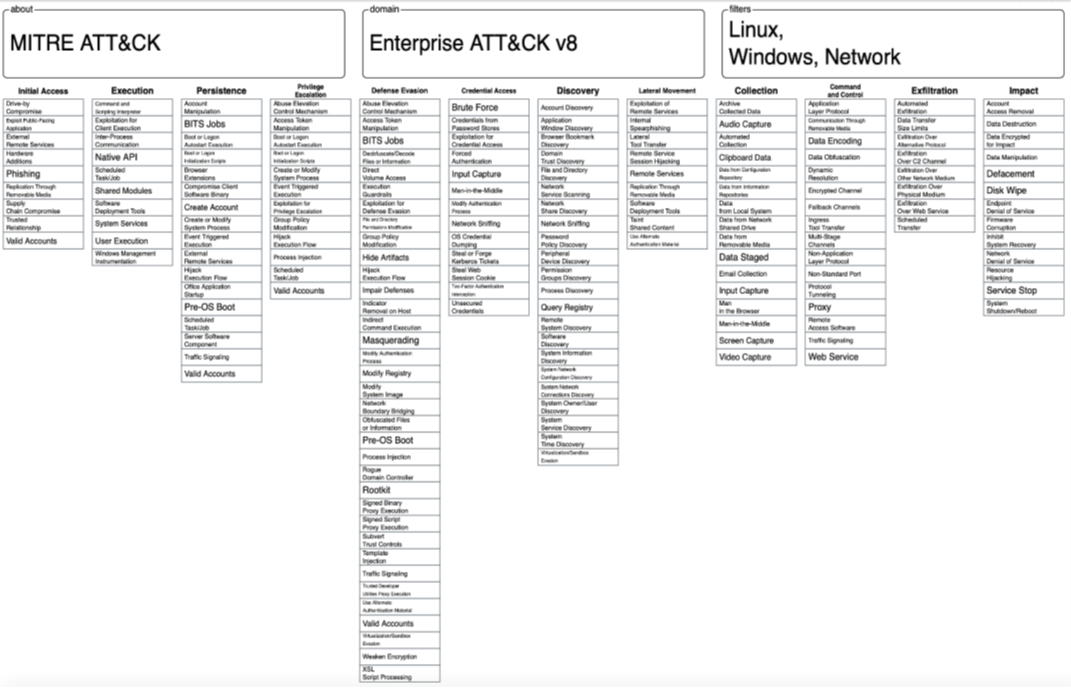
Every attack in the engagement is mapped to the MITRE ATT&CK framework, which records the tactic, the technique, and the tooling used at each phase. Tactics are selected during the threat-profile phase. Mapping the engagement this way is what lets your SOC measure its own detection coverage against real adversary behaviour rather than against a generic checklist.
Techniques in scope
Alongside the framework, our consultants use commercial tooling including Burp Suite Pro, Acunetix, and Cobalt Strike.
What you receive.
Detailed Report
The methods used, the vulnerabilities and exploits identified, and the recommendations that follow from them.
Presentation
The key findings summarized and delivered to senior management and the other stakeholders who act on them.
Recommendations and Action Plan
A prioritized plan built from the exploits actually achieved during the engagement, not from a generic list.
Where this connects.
Infrastructure Penetration Testing
Scope-based technical testing. Red teaming is objective-led and takes the whole organization in scope.
SOC Operations Assessment
Grades the detection function a training-led red team engagement is designed to exercise.
Security Monitoring
The 24/7 analyst capability whose detection coverage the ATT&CK mapping measures.
Common questions.
How is red teaming different from a penetration test?
A penetration test proves technical exposure. Red teaming works from an adversarial point of view against the whole organization, testing whether your defensive mechanisms can be circumvented and whether your team detects and responds while it happens.
Which engagement type should we choose?
Objective-led runs against a specific target, such as accessing an ERP system or compromising an executive device. Training-led is interactive and lets the blue team practise detection. Threat intelligence-led builds the scenario from real threat intelligence reports.
Does our security team learn anything from it?
Yes, that is part of the point. The engagement gives security personnel hands-on experience responding to authentic threat scenarios, and evaluates crisis procedures to find improvements in detection and reaction.
What do we receive?
A detailed report covering methodology, vulnerabilities, and remediation, an executive presentation, and a prioritized action plan.